
Running a Fulton County Sex Offender Check
The Georgia State Sexual Offender Registry is the main public channel for a Fulton County sex offender check. The Georgia Bureau of Investigation and Georgia Crime Information Center manage the statewide system. County sheriffs collect local registration information, verify required details, and transmit updates. Fulton County's unit maintains information for people who live, work, or attend school in the county.
Start with the statewide gateway, then use the Fulton County Sex Offender Unit when an address appears wrong or a local fact needs confirmation. The registry help line can address use of the state system. The sheriff is the better contact for local compliance and address reports. Neither route should be treated as a substitute for reading the full profile and its conditions of use.
Fulton Registry Conditions Gateway
The public gateway opens with Conditions of Use. A user must choose “I agree” before reaching the search controls. That step matters because GBI explains that other agencies supply much of the data, facts change often, and the state does not warrant that every entry is complete at every moment.
The official registry interface shown in the GBI source view demonstrates why the conditions come before any name or map query.
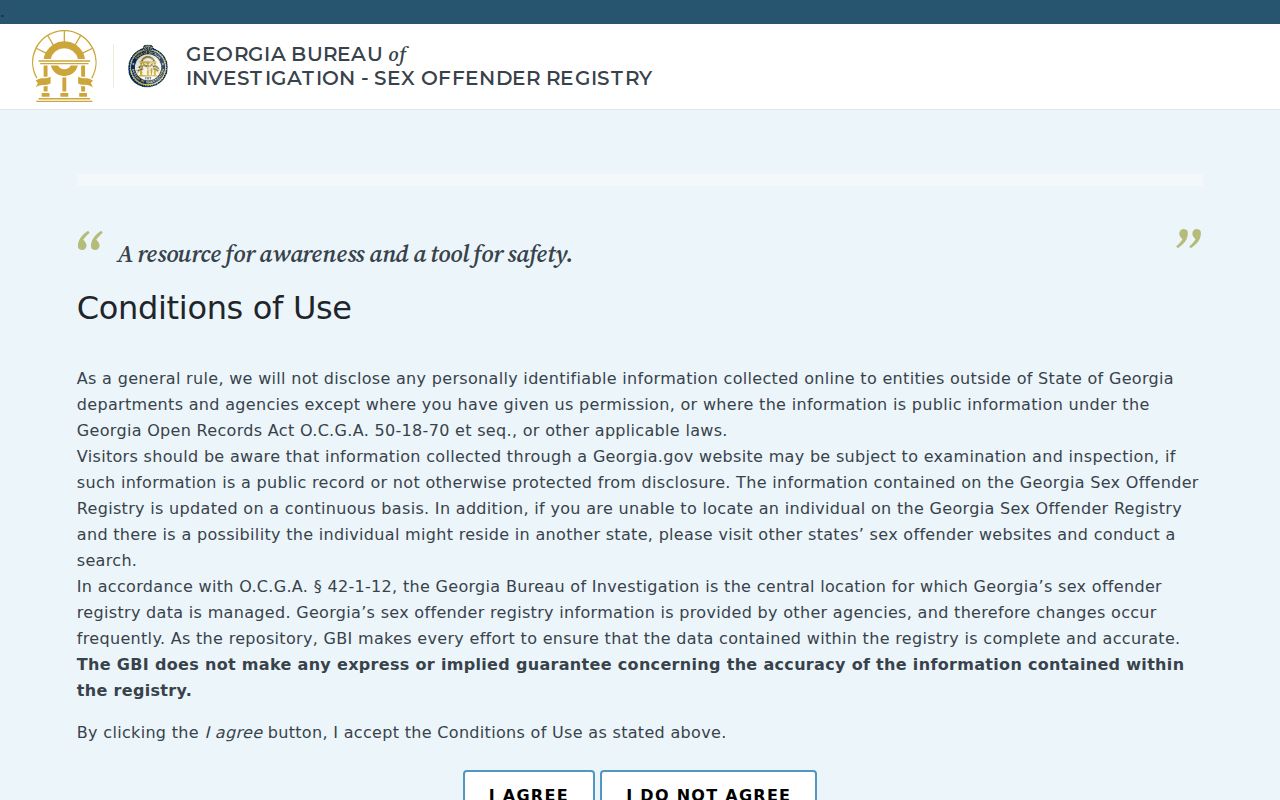
Accepting the conditions does not reduce the need to verify a Fulton County registry result with the sheriff or GBI.
Searching the Georgia State Sexual Offender Registry
The internal fields can change, and the public gateway does not expose every control before acceptance. Use only the choices shown in the live form. Avoid guessing at a radius or assuming that a map result includes every person tied to Fulton County.
- Open the official registry gateway and read the conditions.
- Accept the conditions, then enter a name or available geographic detail.
- Use Fulton as the county filter when the live form offers it.
- Compare the result list, then open the profile that matches known facts.
| Field or control | Type | Required | Use |
|---|---|---|---|
| I agree / I disagree | Buttons | Yes | Controls entry to the public search |
| Name | Text | Portal-dependent | Search with the spelling shown in official records |
| Address | Text | Unverified | Confirm availability in the live geography search |
| City, ZIP, or county | Text or select | Unverified | Use Fulton when the county choice appears |
| Radius or map | Search control | Unverified | Use only the distances and views displayed live |
Why Fulton Registry Data Shifts
GBI describes the registry as updating daily or continuously, but that does not mean every real-world change appears at once. A registrant reports through a sheriff. The sheriff then updates offender-supplied data in the state system within two business days. Moves between counties, recent releases, and corrections can create a short gap between the local event and public display.
A missing result is not proof that no registration history exists. The cause might be search input, a nonqualifying offense or date, First Offender handling, relocation, death, a recent submission, or information that is not public. Check alternate spellings and geography, then call the proper official unit if the question remains.
What a Fulton Registry Profile Shows
A public profile combines identification, location, conviction, and compliance categories. Exact publication varies, so searchers should read the labels on the live profile and avoid copying personal details into unofficial lists.
| Name and aliases | Published names used to distinguish the registered person. |
|---|---|
| Photo and description | A current submitted image and physical traits where published. |
| Registered locations | Residence and other work or school locations subject to publication. |
| Offense information | Conviction, offense, and statute details provided to the registry. |
| Risk classification | Georgia classification when one has been assigned. |
| Status and compliance | Registration standing, verification facts, vehicles, or marks where collected and public. |
One field rarely settles identity. Compare several neutral facts. Then contact the Fulton County Sex Offender Unit rather than acting on a photo, address, or name alone.
Fulton County Registry Unit
The Fulton County Sex Offender Unit is located at 185 Central Avenue, 9th Floor, Atlanta, and can be reached at 404-612-9130. It keeps the county listing and transmits local updates to GBI. The state registry help number is 404-270-8399 for questions about the public system.
Report a suspected wrong Fulton address to the county unit. Give enough information to identify the profile and explain the possible error. Do not confront the person shown. Verification and compliance work belongs to law enforcement.
Fulton County Sex Offender Unit
185 Central Avenue, 9th Floor
Atlanta, GA
404-612-9130
Registration Requirements and Levels in Georgia
Georgia does not use a simple public “10 years, 25 years, life” tier model. It uses risk classifications, while registration is generally lifetime. A classification describes assessed risk and may affect statutory duties or a later petition. It is not a shorthand for the facts of the conviction.
| Classification | Duration | Key consequence |
|---|---|---|
| Level I | Generally lifetime | Low-risk classification may support a statutory release petition |
| Level II | Generally lifetime | Intermediate-risk classification |
| Sexually Dangerous Predator | Lifetime | Six-month reporting and GPS duties under O.C.G.A. § 42-1-14 |
Qualifying registrants report in person within 72 hours of release, supervision placement, or entry into Georgia. Annual renewal occurs within the 72 hours before a birthday for updated photos and fingerprints. Address changes are also generally subject to a 72-hour reporting rule.
Fulton Checks Across State Lines
A Fulton County search can miss a record tied to another state. The National Sex Offender Public Website queries participating jurisdiction registries and is the official federal layer for a broader geographic check.
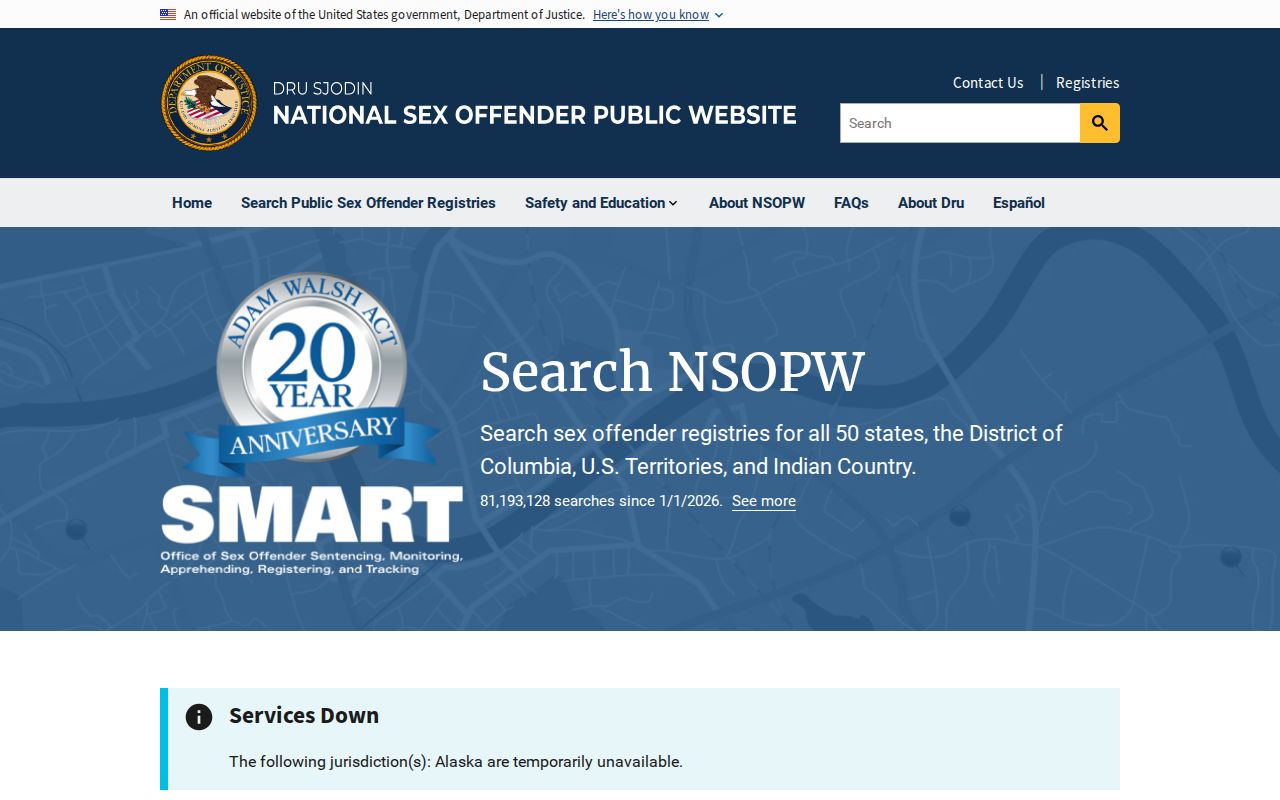
NSOPW is useful for cross-state awareness, but its results still depend on participating jurisdictions and their updates. Return to the source jurisdiction for the full official profile.
Fulton Residence Rules Need Dates
Georgia residence and activity restrictions depend on conviction facts and dates. They should not be applied to every Fulton County registrant as one broad rule. For certain acts committed from July 1, 2006 through June 30, 2008, O.C.G.A. § 42-1-16 addresses 1,000-foot restrictions involving child care facilities, churches, schools, and places where minors gather.
That date-specific rule shows why a map pin alone cannot answer whether an address is lawful. The relevant offense date, statute, order, and any exception must be checked. Questions about a specific person's compliance should go to the Fulton County unit.
Leaving Georgia's Registry
Removal is not an administrative request to the registry operator. O.C.G.A. § 42-1-19 creates a court petition process. Depending on the ground, a person files after completing the sentence and supervision and meeting statutory conditions. A general route may involve ten years after completion or a Level I classification.
The petition goes to the convicting Superior Court, or in some out-of-state cases to the Superior Court where the person lives. The district attorney and relevant sheriffs receive service. A denial ordinarily brings a two-year wait before another petition. The signed court result, not an assumption based on elapsed time, controls.
GBI Guidance for Fulton Searches
GBI's official registry FAQ explains the reporting clock, annual updates, sheriff duties, and common questions. The GBI registry FAQ is the best source when a Fulton County question turns on state procedure.
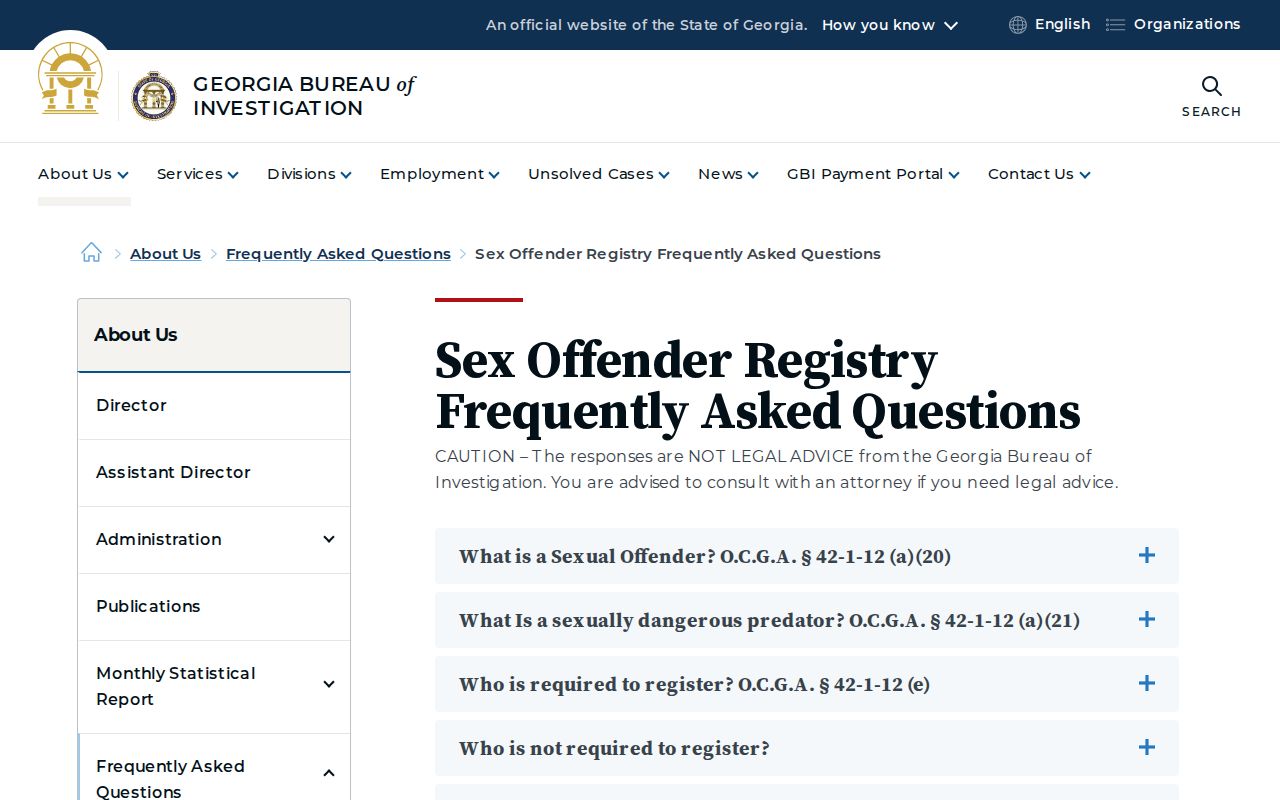
The FAQ adds statutory context, while the live registry and Fulton sheriff remain the sources for a current public result and local correction report.
Lawful Use and Community Notification
Registry information is published for awareness and safety planning. Use it to understand an official record, plan for family safety, or raise a factual concern with law enforcement. Confirm the profile, its status, and its location before relying on it. Do not publish unofficial accusations or treat an entry as permission to contact a registrant or household.
Use registry information lawfully: Threats, harassment, intimidation, or vigilantism are not authorized and may be crimes under Georgia law. Report concerns to the Fulton County Sheriff or GBI.
Community safety works best when tips are precise and routed to the agency that can verify them. The registry is a notification source, not a tool for punishment outside the law.