
How to Check Fulton County Criminal History
Begin with the record that can answer the question. The Fulton Clerk's Find a Case page routes Superior, Magistrate, and State Court searches. The current Tyler portal requires registration or sign-in before Smart Search and its advanced controls can be used. A full name, spelling variants, a case number, and a narrow filing-date range help separate people with similar names. The portal does not replace a clerk request when a file is old, sealed, unavailable online, or held by a different court.
Booking and custody facts take a different route. Use the sheriff for a recent Fulton jail entry and the arresting police agency for the incident narrative. Georgia Felon Search covers public in-state felony-conviction information, while a person seeking a fuller review of their own Georgia history should follow GCIC inspection or fingerprint procedures. Compare the case number, court, dates, and permitted identifiers before treating any hit as a match.
- Choose the custodian: clerk for a case, sheriff for a booking, or the arresting agency for a police report.
- Search with the most exact identifier available, then narrow by court and date.
- Open the underlying docket or booking detail and distinguish allegations from outcomes.
- Check statewide conviction or corrections sources when the question extends beyond Fulton County.
- Order a certified copy or personal record inspection when an official document is required.
Fulton Court Search Gateway
The Tyler gateway exposes Register, Sign In, Smart Search, Advanced Search Options, and Make Payments. Its internal fields are gated, so options that cannot be seen before authentication should not be guessed. A blank result can mean the wrong court collection, a spelling issue, a restricted record, a filing lag, or a case outside the portal's coverage. It does not prove that no record exists.
| Control | Use | Access note |
|---|---|---|
| Smart Search | Record number or party-name search | Sign-in required |
| Advanced Search Options | Narrow a broad result | Internal choices must be confirmed after login |
| Court records | Select the judicial collection | Jurisdiction affects results |
| Make Payments | Payment workflow | Payment is not proof of disposition |
The official Clerk routing page shows where the search begins.
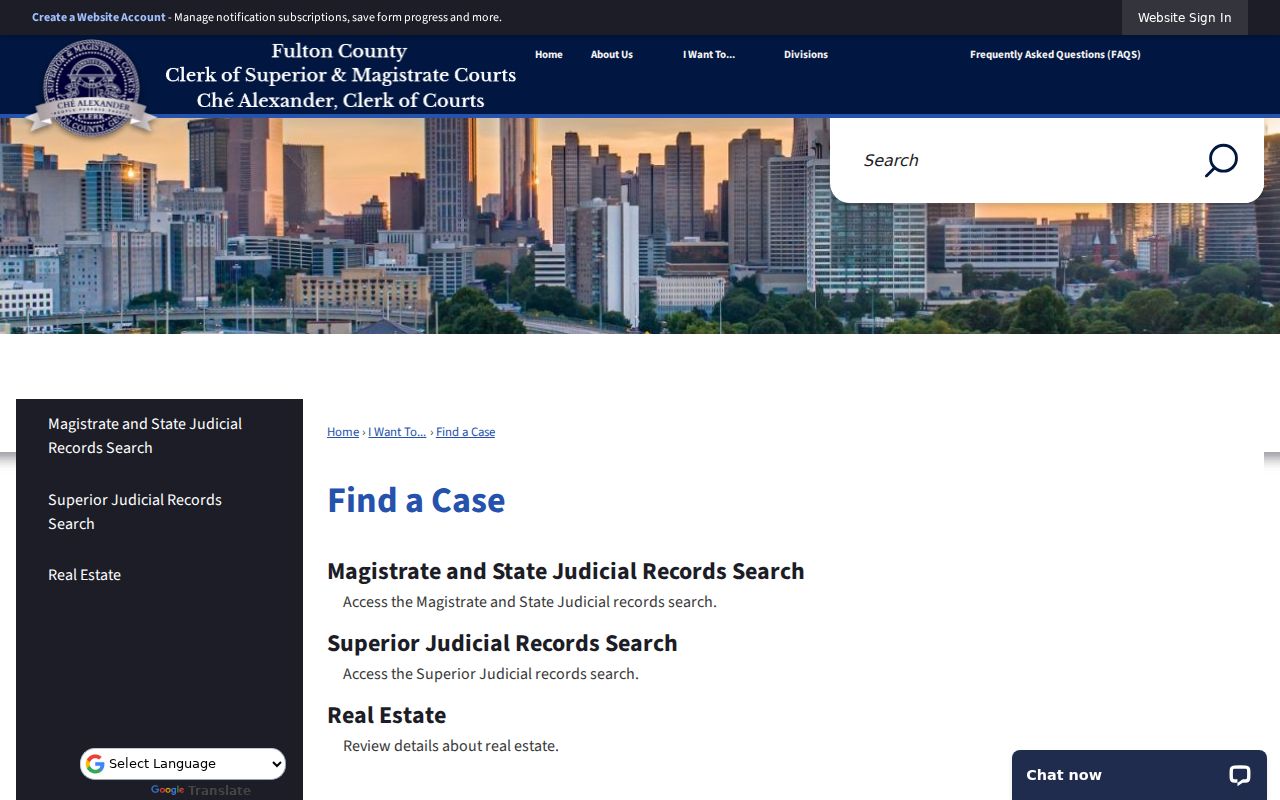
The image reinforces an important limit: the correct court and record series must be selected before interpreting the result.
Official Georgia Background Checks
The Georgia Bureau of Investigation's Georgia Crime Information Center is the central repository for arrest, disposition, and custodial criminal-history data. Public Georgia Felon Search uses full name, race, sex, and date of birth to return qualifying in-state felony-conviction information. It is narrower than every record GCIC may hold. Local law-enforcement agencies may also provide authorized Georgia criminal-history checks under their own procedures and fees.
A fingerprint-supported review serves a different purpose. Georgia Applicant Processing Service uses IdentoGO for an authorized service code, registration, an appointment, valid photo identification, and the fee shown for that service. People inspecting or challenging their own GCIC history should follow GBI instructions. An FBI Identity History Summary is a separate, subject-only national check and does not replace Fulton docket papers.
Fulton Records Reach GCIC
Fulton County criminal records do not move as one file. A police agency sends a fingerprintable arrest transaction to GCIC with identifiers such as an Originating Agency Case Number and Offender Tracking Number. The sheriff creates a separate jail booking if the person enters county custody. Prosecutors and courts later report dispositions, while corrections and supervision agencies add post-sentence events. Timing and identifier mismatches can leave each source showing a different slice.
The Judicial Council's Criminal Case Data Exchange dashboard tracks disposition transmissions by OTN. Its court-by-court e-access directory shows why no single free statewide search replaces the Fulton portal.
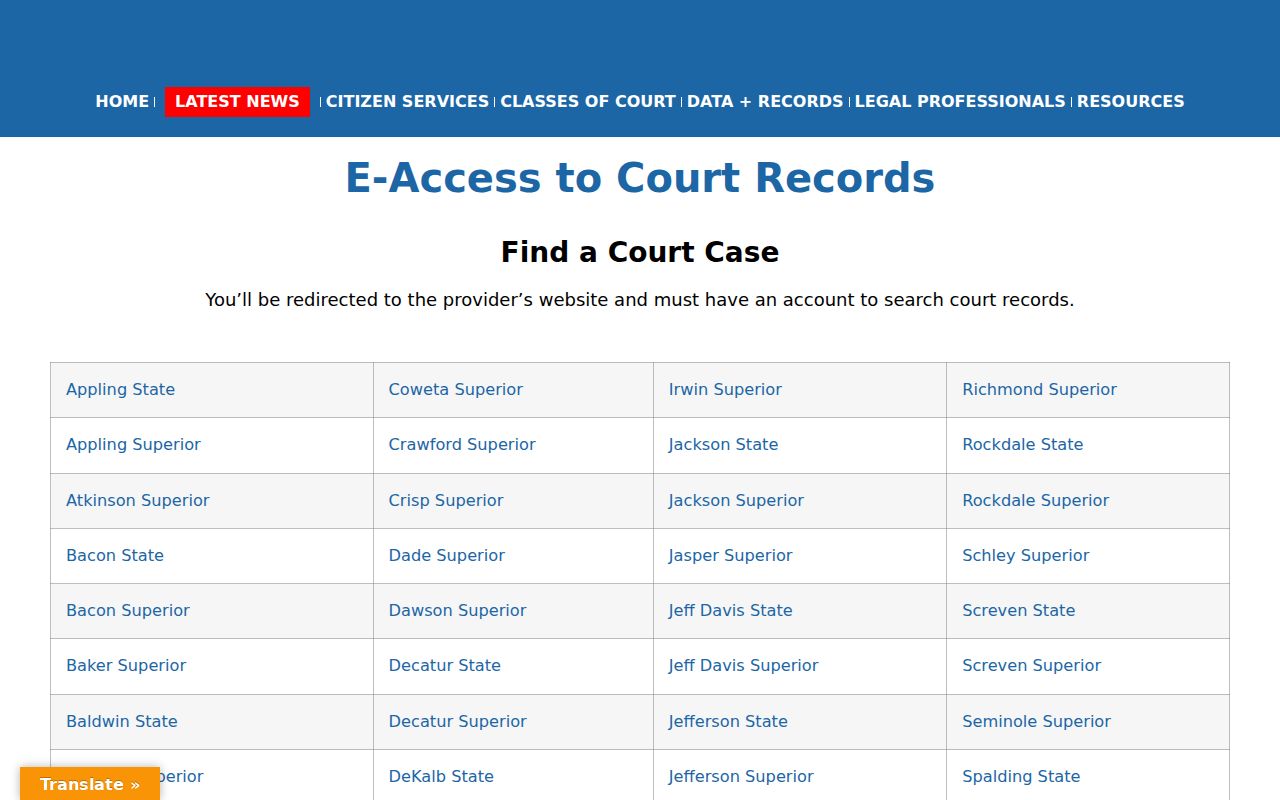
Georgia's court-by-court access model explains why the county docket and state repository should be checked as related but distinct systems.
Types of Criminal Records in Fulton County
Record type determines both meaning and custodian. An incident report contains the investigating officer's narrative. An arrest report explains the asserted legal basis for taking a person into custody. A booking entry records jail intake. Court files then show what prosecutors filed and what the judge or jury decided. GCIC connects reported arrest cycles and outcomes, while GDC publishes information for state-sentenced people.
- Police reports: held by the agency that investigated the event.
- Bookings: held by the detention agency that received the person.
- Court cases: held by the clerk for the court with jurisdiction.
- State history: maintained from agency submissions by GCIC.
- Corrections and registry records: published through GDC and the Georgia State Sexual Offender Registry.
Fulton Courthouse Custodians
Several record holders sit in Atlanta's downtown justice district, but they are not interchangeable. The Lewis R. Slaton Courthouse houses the Superior and Magistrate clerk functions. The State Court Criminal Division handles misdemeanor and traffic files at a separate Central Avenue address. The District Attorney works from the Pryor Street complex, while jail records originate at the Rice Street detention operation.
Superior and Magistrate Clerk
136 Pryor Street SW, Atlanta, GA 30303
404-613-5313
State Court Criminal Division
185 Central Avenue SW, Atlanta, GA 30303
404-613-5040
Fulton County Jail
901 Rice Street NW, Atlanta, GA 30318
404-613-2000
The Fulton Superior Court site provides court calendars and division information.
Online information complements the clerk's record counter; one should not be treated as a substitute for the other.
What a Fulton County Criminal Record Shows
The fields depend on the source. A court docket can identify the case, parties, assigned judge, filing date, charges, hearings, motions, outcome, sentence, and document links. A booking record focuses on intake and release. GCIC groups identity-linked cycles submitted by agencies. Read each charge beside its disposition because the arrest label may differ from the accusation, indictment, plea, or judgment.
| Name & Identifiers | Names, aliases, date of birth where law permits, case number, OTN, SID, or booking number. |
|---|---|
| Arrest / Booking Data | Arresting or delivering agency, intake date, facility, initial charges, bond, release date, and release reason. |
| Charges & Statutes | Filed counts and cited Georgia provisions, which may differ from intake allegations. |
| Disposition | Dismissal, nolle prosequi, plea, verdict, or other result for each count. |
| Sentence | Custody, probation, fines, conditions, and First Offender treatment when ordered. |
| Custody / Supervision Status | County jail, GDC, probation, or parole information from the responsible source. |
Fulton Jail Booking Data
The sheriff's public booking dataset covers admissions to Fulton detention facilities since 2014 and is updated daily. It can show booking date and time, booked-at facility, delivering agency, and, after release, the release date, time, and reason. Charge and bond detail may require Arrest Inquiry, a phone call, or the Main Jail lobby. A booking is proof of intake, not guilt.
The delivering-agency field is especially useful because Fulton County contains Atlanta Police, municipal departments, campus agencies, MARTA Police, state officers, and sheriff personnel. It points a requester toward the agency that likely holds the narrative. For state custody, use GDC Find an Offender. The Georgia Public Defender Council directory supplies a separate defense-office route.

The defender directory adds a court-support route but does not supply booking or docket records.
Public Access Laws for Fulton County Criminal Records
The Georgia Open Records Act favors access to existing public records unless a specific exemption applies. A written request is prudent because it defines the scope, creates a record of timing, and supports enforcement. An agency ordinarily responds within three business days by producing available material or stating the production time, expected cost, or legal basis for withholding. The law does not require staff to create a new summary.
Key Statutes:
O.C.G.A. §§ 50-18-70 through 50-18-77 govern requests, response duties, costs, and exemptions.
O.C.G.A. § 35-3-34 controls access to criminal-history information, including public felony-conviction searches.
O.C.G.A. § 35-3-37 establishes Georgia record restriction.
O.C.G.A. § 42-1-12 governs registry publication and sheriff duties.
Fulton Open Records Routing
Send a request to the office that created or keeps the record. The sheriff handles sheriff incidents, jail material, and detention records. Judicial files go to the clerk. Atlanta and other city police reports stay with those city agencies. Fulton County's broader open-records channel can track county administrative requests, but it does not turn the County Attorney into the custodian for court files.
A focused request names the record type, date range, location, person or entity, and incident, booking, or case number if known. Ask for existing electronic records and a cost estimate. If part of a file is exempt, request the segregable nonexempt portion. Protected victim information, juvenile material, medical data, security details, and sensitive identifiers may be redacted.
The Fulton District Attorney page identifies the charging office and its programs.

The prosecutor's file and the clerk's court file serve different roles, even when both concern the same prosecution.
Sealed, Expunged, and Restricted Records
Georgia uses the term record restriction. Restriction does not destroy the record. It limits ordinary public and private dissemination through GCIC, while authorized courts and criminal-justice agencies may retain access. Court sealing is a separate step that may be needed to limit courthouse material. Copies obtained before restriction are not pulled back from private holders.
For an arrest before July 1, 2013, the applicant generally completes the first part of the state form and routes it through the arresting agency and prosecutor. The agency fee may not exceed $50. When an approved form cannot be entered electronically, GCIC lists a $25 processing payment. Later arrests are commonly addressed through prosecutor and sentencing processes. Fulton County also has a District Attorney division for diversion, records, and record-restriction requests. Juvenile files and records sealed by court order follow distinct access rules.
Fulton State and Federal Layers
A Fulton search may need to extend beyond county court. GDC covers the state correctional system, and DCS administers felony community supervision. The Georgia State Board of Pardons and Paroles addresses parole decisions. Federal prosecutions belong to the U.S. District Court for the Northern District of Georgia, Atlanta Division, and are searched through PACER rather than the Fulton Clerk.
The Northern District court site identifies the federal clerk and Atlanta Division.
Federal, state, and county records can concern the same conduct, yet each system keeps its own docket and custody information.
Criminal Records by City in Fulton County
Fulton's three largest incorporated cities each add local police and municipal-court records. Atlanta operates the county's largest city court and its own detention channels. South Fulton provides two report pickup counters and weekly district-level statistics. Sandy Springs now combines police and municipal-court functions at Morgan Falls, while contract jail arrangements can change the first custody lookup. City cases may later move to Fulton courts, but the local agency remains the source for its original report.
Atlanta Criminal History
520,070 · APD records and Atlanta Municipal Court case access
South Fulton Criminal History
112,003 · Central Records counters and municipal court routes
Sandy Springs Criminal History
105,505 · Morgan Falls police and court records
Fulton Diversion Court Records
Not every case follows the same path from charge to trial. Fulton Drug Court describes an 18-month treatment and monitoring model. Behavioral Health Court combines treatment with judicial oversight for qualifying participants, and Veterans Court is described as an 18-to-24-month program with case management, testing, supervision, and monthly court review. These programs create orders, progress entries, and disposition records, while health and treatment details may remain protected.
The Superior Court's official program pages provide the right source for current eligibility and calendars. A specialty-court entry should be read with the final docket result, not as a stand-alone statement of conviction.